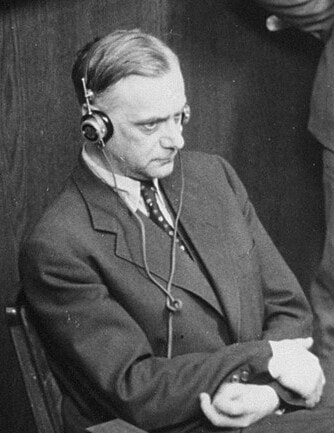
 Alfred Rosenberg, author of 'Mythus of the Twentieth Century', at his Nuremberg trial. Alfred Rosenberg, author of 'Mythus of the Twentieth Century', at his Nuremberg trial. In my book Wednesdays with Wally, I give the account of his years in Berlin as an American university student in the 1930s. When he first arrived, sometime in June, 1933, one of the things Wally had to do was make a special delivery for his former employer, a Jewish businessman from New Orleans. To find out where to make his delivery, Wally needed to find out how to get to where he needed to go. He didn’t yet know his way around Berlin. Wally’s landlady, an older woman named Frau Schoebel, told him to go to a nearby bookshop and buy a map. He found the bookseller and noticed that bookstore of 1933 Berlin looked very different than its American counterparts. Wally was unaware that the year before he arrived at the University of Berlin, more than 22,000 volumes from that University’s library were burned in a socialist rally. Bookstores which sold unapproved books found themselves with shattered windows or were firebombed. Police were unwilling to investigate these crimes, because the Nazis, now Germany’s ruling party, were behind the crimes. In its front window, the bookstore Wally went to had copies of the two officially-approved “bestsellers” displayed prominently, along with a framed photo of Adolf Hitler and little Nazi flags. Those two bestsellers were Adolph Hitler’s autobiography Mein Kampf, and Mythus of the Twentieth Century by Alfred Rosenberg. Readers and historians are aware of Mein Kampf, but many haven’t heard of Rosenberg’s Mythus. Many loyal Nazi households in 1930s Berlin kept a copy of Mythus sitting in their home, often in a prominent place — like today’s coffee table books or a family Bible. The author of Mythus had an interesting — and checkered — past. Alfred Rosenberg was a former Bolshevik from the Balkans. An ethnic German, Rosenberg fell out with the Russian leadership of that country’s socialist revolution of 1917, and fled to Germany, where he also had citizenship. Like many other German socialists, Rosenberg gravitated toward Nazism. According to American journalist William Shirer, CBS News’s Berlin station chief in the 1930s, there were rumors of Rosenberg having had a financial falling out with Russian Bolsheviks before his move to Germany. Rosenberg would later find a more appreciative audience in another expression of socialism, the pro-German (and anti-Russian) Nazis. “Rosenberg was one of Hitler’s ‘spiritual’ and ‘intellectual’ mentors, though… he strikes me as extremely incoherent and his book Mythus of the Twentieth Century, which sells only second to Mein Kampf in this country, impresses me as a hodgepodge of historical nonsense.” — William Shirer, Berlin Diary Socialist movements of all kinds need ideologies that claim the moral high ground — no matter whether they actually have it or not. Rosenberg — and today’s socialists — claim they act for the good of everyone involved. As George Orwell would point out, this kind of claim is especially for the good of the leaders of a ruling party. Rosenberg knew this. He was a pseudo-intellectual and a writer who claimed to speak for the good of the people. Drawing on dubious sources, and fabricating a false history with just a few facts thrown in, Rosenberg wrote Mythus based on racial themes. He portrayed Western civilization as having been formed and transformed by the “superior” German race. Rosenberg wrote that the Germans, in turn, had then been persecuted by “lesser” races, such as Slavs and Jews. It was time, claimed Rosenberg, for Germans to ascend to their proper place. Rosenberg used a doctrine of racial hatred that claimed Socialism was the answer to save this “master” race. Rosenberg claimed that confiscation of property and violation of human rights were necessary to prevent anti-German racism. Now in 21st Century America, instead of the 1930s Berlin, we see something familiar. The Rosenberg approach has made a comeback. With lots of financial backing, and with the endorsement of well-paid promoters, the 1619 Project is essentially the same book as Mythus of the 20th Century. It has the same goal. It means to divide rather than to unify. It justifies violence on the grounds of a false moral superiority, encouraging revenge. Also, 1619 Project endorses a form of socialism as the only solution. (Ignoring 150 years of evidence for the economic failure of socialism in all its forms.) Socialism - in any form - has nothing to do with equality or fairness. It reestablishes a ruling class over a class of those who are required to farm, manufacture and serve the rulers. Socialism re-creates the serf class. And a serf system always benefits those with money and power. This is how Rosenberg was able to publish his book. Moneyed interests in Europe wanted serfs. It is how the 1619 Project — and Critical Race Theory — became so highly promoted. Many people with power and money want a serf class. The self-styled “lords“ over the would-be “serfs“ call for a redistribution of the wealth of others to the interests of the “ruling class”. They spend loads of money to destroy human independence and enforce dependence on this newly-created serf system. True equality respects the rights of each individual. And it is the job of each individual to take responsibility for himself.
0 Comments
 Wally Carr Wally Carr “He who has a library and a garden lacks nothing.”
Cicero was right. Getting up before daylight, my first hours are spent in our library. That sounds kind of snooty, talking about my library. In reality, the house I live in IS a library. There are bookshelves in the bedrooms, hallways, guest bedrooms and even in a bathroom. Open a cabinet and you’ll find even more books. Books even fill a walk-in closet where clothes are supposed to be. “Si Hortum in bibliotheca babes, deerit nixit,” as Wally would say Cicero’s quote, in the original Latin. He lived in a tiny apartment walking distance to the Lexington Public Library and the University of Kentucky Arboretum. Wally spent hours reading in libraries, walking through the University’s plantings, and was a happy and grateful man. Wally had the Cicero lesson down pat. He didn’t have much money, a yard or even a potted plant. But he had access to books and the beauty of a garden. Back in 1980s Lexington, Kentucky, the elderly William Wallace “Wally” Carr walked all around the University of Kentucky campus and throughout downtown at all hours. Usually disheveled, he was often mistaken for being homeless. He didn’t own a TV or car (or money). Wally probably wouldn’t have used them if he had. He was a professional Ciceronian. Wally was a grateful man. He lacked nothing. Books are a life essential. Wally knew that. Stoic philosopher Epictetus (50-135 AD) valued books more than gold and silver. He said a book’s greatest value is for its readers to apply the lessons they learn from it. Epictetus asked; “Tell me, what reason do you have to read? If you aim at nothing beyond mere enjoyment… you are just a poor, spiritless knave. But if you want to study to its proper end, what is your life other than a tranquil and serene existence?” Wally lived in the East Maxwell Street area known as the “Student Slums”. The area earned that title because it was close to the University of Kentucky campus and had lots of decrepit old houses divided into decrepit little rental units. Like his father, the great American Classics professor Dr. W.L. Carr, unless he was given a ride by someone with a vehicle, Wally walked everywhere he went. Now it’s almost 30 years since Wally’s death and I’m 800 miles away from Lexington. Getting up before sunrise, I start most days reading. When the sun’s up, I walk through the garden. With the garden, I help the plants grow. With books, I help myself to grow. These are the keys to Cicero’s — and Wally’s — greatness.
|

About claude E. hammondClaude Ellis Hammond, J.D., is a continuing education professional. He speaks frequently on historic and esoteric subjects. He's also an expert on coffee and drinks a lot of it. ArchivesCategories |

 RSS Feed