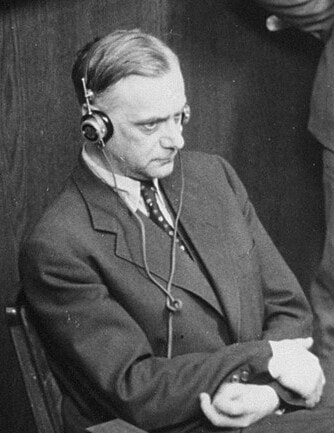
 Alfred Rosenberg, author of 'Mythus of the Twentieth Century', at his Nuremberg trial. Alfred Rosenberg, author of 'Mythus of the Twentieth Century', at his Nuremberg trial. In my book Wednesdays with Wally, I give the account of his years in Berlin as an American university student in the 1930s. When he first arrived, sometime in June, 1933, one of the things Wally had to do was make a special delivery for his former employer, a Jewish businessman from New Orleans. To find out where to make his delivery, Wally needed to find out how to get to where he needed to go. He didn’t yet know his way around Berlin. Wally’s landlady, an older woman named Frau Schoebel, told him to go to a nearby bookshop and buy a map. He found the bookseller and noticed that bookstore of 1933 Berlin looked very different than its American counterparts. Wally was unaware that the year before he arrived at the University of Berlin, more than 22,000 volumes from that University’s library were burned in a socialist rally. Bookstores which sold unapproved books found themselves with shattered windows or were firebombed. Police were unwilling to investigate these crimes, because the Nazis, now Germany’s ruling party, were behind the crimes. In its front window, the bookstore Wally went to had copies of the two officially-approved “bestsellers” displayed prominently, along with a framed photo of Adolf Hitler and little Nazi flags. Those two bestsellers were Adolph Hitler’s autobiography Mein Kampf, and Mythus of the Twentieth Century by Alfred Rosenberg. Readers and historians are aware of Mein Kampf, but many haven’t heard of Rosenberg’s Mythus. Many loyal Nazi households in 1930s Berlin kept a copy of Mythus sitting in their home, often in a prominent place — like today’s coffee table books or a family Bible. The author of Mythus had an interesting — and checkered — past. Alfred Rosenberg was a former Bolshevik from the Balkans. An ethnic German, Rosenberg fell out with the Russian leadership of that country’s socialist revolution of 1917, and fled to Germany, where he also had citizenship. Like many other German socialists, Rosenberg gravitated toward Nazism. According to American journalist William Shirer, CBS News’s Berlin station chief in the 1930s, there were rumors of Rosenberg having had a financial falling out with Russian Bolsheviks before his move to Germany. Rosenberg would later find a more appreciative audience in another expression of socialism, the pro-German (and anti-Russian) Nazis. “Rosenberg was one of Hitler’s ‘spiritual’ and ‘intellectual’ mentors, though… he strikes me as extremely incoherent and his book Mythus of the Twentieth Century, which sells only second to Mein Kampf in this country, impresses me as a hodgepodge of historical nonsense.” — William Shirer, Berlin Diary Socialist movements of all kinds need ideologies that claim the moral high ground — no matter whether they actually have it or not. Rosenberg — and today’s socialists — claim they act for the good of everyone involved. As George Orwell would point out, this kind of claim is especially for the good of the leaders of a ruling party. Rosenberg knew this. He was a pseudo-intellectual and a writer who claimed to speak for the good of the people. Drawing on dubious sources, and fabricating a false history with just a few facts thrown in, Rosenberg wrote Mythus based on racial themes. He portrayed Western civilization as having been formed and transformed by the “superior” German race. Rosenberg wrote that the Germans, in turn, had then been persecuted by “lesser” races, such as Slavs and Jews. It was time, claimed Rosenberg, for Germans to ascend to their proper place. Rosenberg used a doctrine of racial hatred that claimed Socialism was the answer to save this “master” race. Rosenberg claimed that confiscation of property and violation of human rights were necessary to prevent anti-German racism. Now in 21st Century America, instead of the 1930s Berlin, we see something familiar. The Rosenberg approach has made a comeback. With lots of financial backing, and with the endorsement of well-paid promoters, the 1619 Project is essentially the same book as Mythus of the 20th Century. It has the same goal. It means to divide rather than to unify. It justifies violence on the grounds of a false moral superiority, encouraging revenge. Also, 1619 Project endorses a form of socialism as the only solution. (Ignoring 150 years of evidence for the economic failure of socialism in all its forms.) Socialism - in any form - has nothing to do with equality or fairness. It reestablishes a ruling class over a class of those who are required to farm, manufacture and serve the rulers. Socialism re-creates the serf class. And a serf system always benefits those with money and power. This is how Rosenberg was able to publish his book. Moneyed interests in Europe wanted serfs. It is how the 1619 Project — and Critical Race Theory — became so highly promoted. Many people with power and money want a serf class. The self-styled “lords“ over the would-be “serfs“ call for a redistribution of the wealth of others to the interests of the “ruling class”. They spend loads of money to destroy human independence and enforce dependence on this newly-created serf system. True equality respects the rights of each individual. And it is the job of each individual to take responsibility for himself.
0 Comments
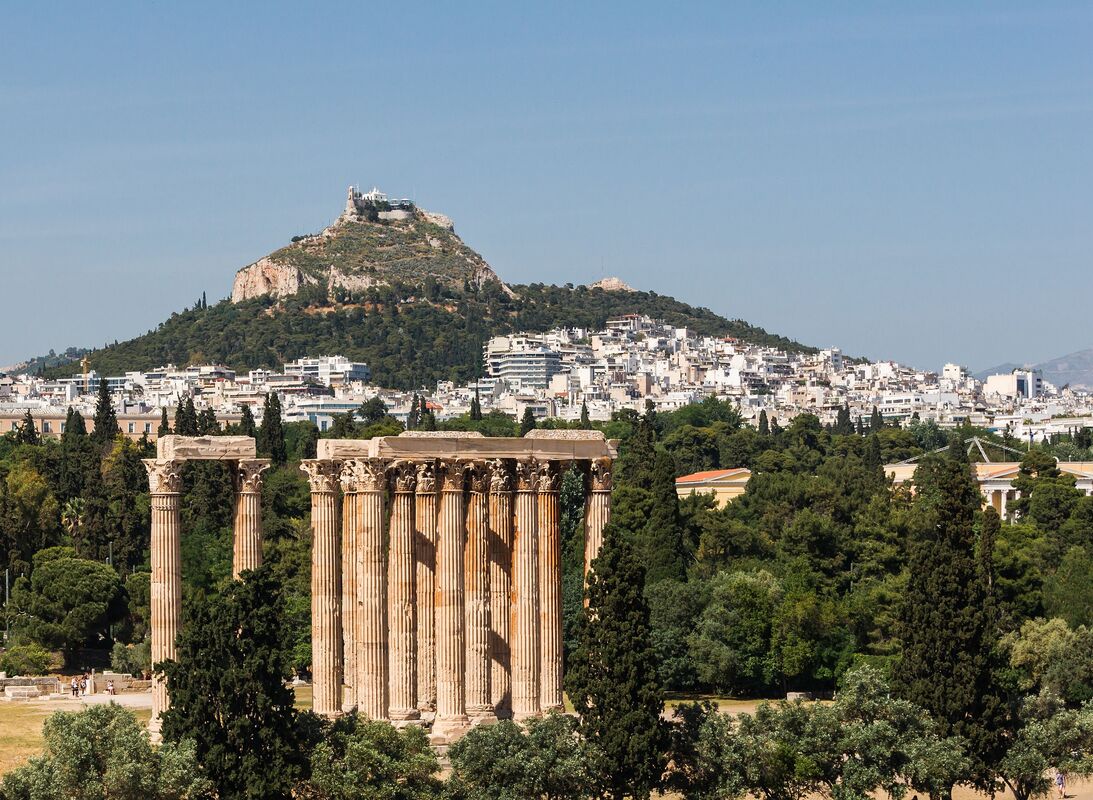 Modern Athens (Wikimedia Commons photo). 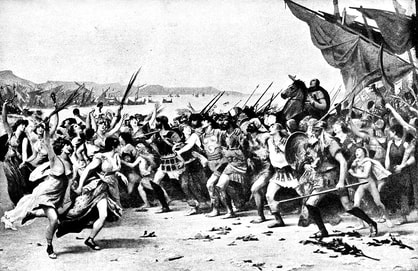 The victory of Themistocles the Athenian at Salamis. (Wikimedia Commons). The victory of Themistocles the Athenian at Salamis. (Wikimedia Commons). Democracy does not equal freedom.
History gives us a great example of a democracy that promoted eugenics, government economic control, and a worthless fiat currency, all more than 2,000 years ago. This was Sparta, the ancient Greek city-state. The word "democracy", as Spartans used it, was not the same as “freedom.” It is not a guarantee of human rights. Democracy is a method. In a society that does not recognize human rights, democracy is a con game that implies — but NEVER guarantees — freedom. Fiercely militaristic and brutal, Sparta had democracy a full century and a half before Athens. But its rulers did not recognize the rights of its citizens. Spartan democracy was mob rule. Sparta enforced brutal militaristic laws written by Lycurges, a 7th Century BCE tyrant. Spartan law required eugenics. Every newborn child was examined; if the child did not meet the physical standards of the law, it was discarded into a pit and left to perish by exposure to the elements and wild animals. Spartan law required that boys to be taken away from their families at the age of seven. The boys would then begin the military training that would continue for the rest of their lives. Spartan boys were taught to fight, wrestle, steal, lie, and forage. They were purposely underfed and had to use those skills or otherwise starve. Part of the military discipline for boys included regular beatings. “So seriously did the Lacedemonian (Spartan) children go about their stealing, that a youth, having stolen a young fox and hid it under his coat, suffered it to tear out his very bowels with its teeth and claws, and died upon the place, rather than let it be seen. …I myself have seen several of the youths endure whipping to death at the foot of the altar of Artemis…” — Plutarch Seeing boys beaten to death was a common experience in Sparta. It was a brutal way of discipline and seen as an aspect of growing into manhood. This continued into adulthood with Spartan soldiers being brutally treated by their commanders. By the time a boy was a teenager, he had frequently seen death. One can understand how Spartans became fierce fighters. The boys were taught little else. The Spartan’s duty was to fight for his tyrants, but not for his rights. Theirs was a North Korean sort of democracy. Spartans were not allowed to own gold and silver. That city-state issued an iron coin that was worthless in every other city. This discouraged trade with outsiders. It discouraged innovation. Foreigners could only trade with the Spartan government or its elites -- and not its commoners. The worthless iron currency prevented Spartans from fleeing their city for a better life elsewhere, and gave the government control of what could be bought and sold. Spartan monetary policy repressed industry and business. Without the ability to export for precious metals that could be spent almost everywhere else in the ancient world, Spartans were not motivated to work in any kind of commerce. And then there were the Athenians. Athenian democracy developed about 150 years after Sparta. It accelerated after Cleisthenes reformed the government and established the individual rights of each Athenian. When an Athenian went into battle, he was not fighting for his homeland, or for a tyrant, or even for his government. The typical Athenian soldier fought for himself and his rights. This difference between Sparta and Athens was put to the test early. Cleisthenes’ reforms alarmed Sparta. Its army joined with the forces of Isagoras, the deposed Athenian tyrant (in 508-507 BCE), to overthrow the new government and its concept of human rights. It should have been an easy task for the Spartans. Their army had the most powerful infantry in the world at that time. They invaded Athens and… Sparta’s army was destroyed. The common people of Athens rose up. They fiercely defended their rights against Sparta and tyranny. So personal freedom in Athens had immediate results. And those results were dramatic. The arts and literature blossomed. So did technology. The age of Pericles, a mighty commoner who led Athens for more than 30 years, transformed that city. Athenian businesses were promoted. Its merchants and businesses prospered, being paid in silver and gold. Athenian economic power increased. With the resulting wealth, the arts, philosophy and literature prospered. Athenian technological innovation was unmatched, and it set the stage for a future empire. Today, the world still studies the brilliance of Athenian culture, which eclipses Sparta. Sparta continued as a military power. In future years, that warrior nation would sometimes ally itself with Athens to repel foreign invaders. Sparta’s military would eventually suffer because it never evolved by recognizing the rights of its people. Repression destroys innovation and Sparta‘s military had become technologically inferior. In desperation, Sparta was forced to rely on the Athenian military and its superior technology. An example of Athenian technology saving the day for Sparta was when (480 BCE) Xerxes the Great invaded Greece with what was likely the world’s largest army. Persian troops sacked and burned Athens, but the technologically superior Athenian navy escaped. The Athenian admiral, Themistocles , came before Spartan rulers and urged them to attack the approaching Persian navy. Themistocles’ argument convinced the Spartans to attack, because, if Sparta would not fight, the Athenian navy would depart. With its primitive ships, Sparta would fall in the resulting invasion. The Spartan admiral “…feared that if he withdrew his fleet… the Athenians would sail away, and knew that without the Athenians, the rest of their ships could be no match for the fleet of the enemy.“ — Herodotus The Spartan leaders listened to Themistocles. The invaders were defeated at Salamis, thanks to Athenian technology and innovation. Salamis was a great naval victory over Persia. The Battle of Salamis was also a triumph of an Athenian system that recognized human rights, freedom of commerce, the arts, and innovation, over a stale, state-controlled Spartan system. This point was proven a second time the next year at the Battle of Platea (479 BCE). Athens and Sparta faced the Persians in an immense land battle. As fierce as they were, Spartan forces had to retreat from Persians fortresses because they did not have the technology to lay siege. But the Athenians did. “So long as the Athenians were away, the barbarians kept off their assailants, and had much the best of the combat, since the Lacedamonians (Spartans) in the attack of walled places, but on the arrival of the Athenians, a more violent assault was made… In the end, the valor of the Athenians and their perseverance prevailed…” — Herodotus The Persians had a superior number of soldiers. Athens lay in charred ruins. The Athenians had every reason to admit defeat, but they kept fighting. The Athenians valued their rights, no matter what the situation. Both the naval battle of Salamis and the land battle of Platea were won by Athenian troops due to their dedication to preserving their liberty. The innovation that had resulted from that liberty and from a free economy, made it possible. Great lessons with modern applications are to be learned with this history. 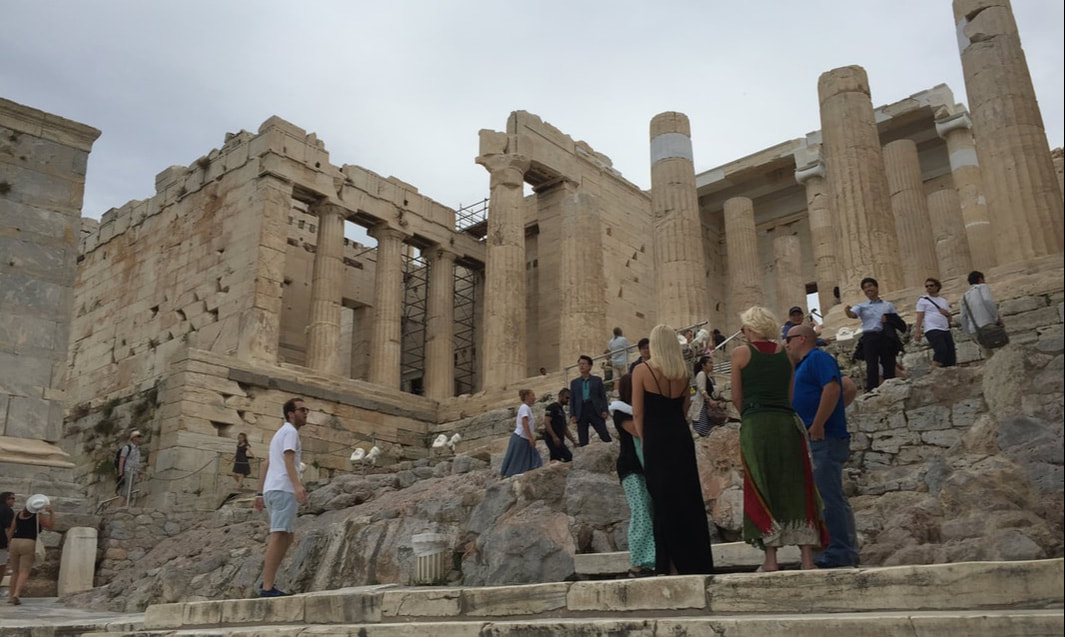 On the steps of the Parthenon, Athens. (Photo Copyright Claude Hammond)  Clisthenes of Athens. (Public Domain) Clisthenes of Athens. (Public Domain) August 25, 2022
“The magistrates were elected according to qualifications of birth and wealth. At first, they governed for life, but later for terms of 10 years.” — Aristotle (Constitution of Athens, Chapter 3) Social class systems are a self-invented curse of humanity. That was true in ancient Greece and it’s true today. The philosopher Aristotle (384-322 BCE) wrote about the harsh class system that existed in Athens in the Sixth Century BCE. The creation of an upper class led to the rulership of one tyrant after another, ruling “democratically”, but being elected for life, or later for 10-year elected terms. All Athenians had until then been divided into four different tribes, with the aristocratic tribes getting special privileges. Excluded from being candidates in their poor semblance of the electoral process were the “commons”, or lower classes. Among these were small business owners, workers, freed slaves and the slaves themselves — the lowest of these tribes was one referred to as “the Accursed.” The very names of the commoners designated not just who they were, but what class they belonged to. Enter the great ruler Clisthenes. Trying to seize Athens’ political power was the aspiring tyrant Isagoras, who had the support of the wealthy Athenian aristocrats. While both Clisthenes and Isagoras were both from the aristocratic class, Clisthenes understood the importance of all Athenians — Commoner and Aristocrat — sharing the same rights. Rallying the commoners, Clisthenes became the Athenian ruler. His reforms would change Western history. “…instead of the four tribes among which the Athenians had been divided until then, Clisthenes made ten tribes, and parceled out the Athenians among them. He likewise changed the names of the tribes…” — Herodotus (Book V) In other words, the labels used to differentiate Aristocrats and Commoners were eliminated. New groups were created and all pretty much had the same rights as Athenians. The rights of Athenian commoners were finally recognized. But Isagoras got the support of powerful Sparta, a powerful city-state with an expert military, who sent its troops to enable Isagoras to forcibly seize Athens. The Athenians rallied behind their newly-found rights. They flooded into the streets to confront Isagoras and his Spartans. “A battle was fought accordingly and the Athenians gained a very complete victory, killing a vast number of the enemy, and taking seven hundred of them alive.” — Herodotus (Book V) The results of this victory were astounding. The idea of defending one’s personal rights, rather than fighting at the whim of some tyrant, was born in Athens. The historian Herodotus (484-425 BCE) describes it best. “Thus did the Athenians increase in strength… These things show that, while undergoing oppression, they let themselves be beaten, since they then worked for a master; but so soon as they got their freedom, each man was eager to do the best he could for himself. So fared it now with the Athenians.”  Wally Carr Wally Carr “He who has a library and a garden lacks nothing.”
Cicero was right. Getting up before daylight, my first hours are spent in our library. That sounds kind of snooty, talking about my library. In reality, the house I live in IS a library. There are bookshelves in the bedrooms, hallways, guest bedrooms and even in a bathroom. Open a cabinet and you’ll find even more books. Books even fill a walk-in closet where clothes are supposed to be. “Si Hortum in bibliotheca babes, deerit nixit,” as Wally would say Cicero’s quote, in the original Latin. He lived in a tiny apartment walking distance to the Lexington Public Library and the University of Kentucky Arboretum. Wally spent hours reading in libraries, walking through the University’s plantings, and was a happy and grateful man. Wally had the Cicero lesson down pat. He didn’t have much money, a yard or even a potted plant. But he had access to books and the beauty of a garden. Back in 1980s Lexington, Kentucky, the elderly William Wallace “Wally” Carr walked all around the University of Kentucky campus and throughout downtown at all hours. Usually disheveled, he was often mistaken for being homeless. He didn’t own a TV or car (or money). Wally probably wouldn’t have used them if he had. He was a professional Ciceronian. Wally was a grateful man. He lacked nothing. Books are a life essential. Wally knew that. Stoic philosopher Epictetus (50-135 AD) valued books more than gold and silver. He said a book’s greatest value is for its readers to apply the lessons they learn from it. Epictetus asked; “Tell me, what reason do you have to read? If you aim at nothing beyond mere enjoyment… you are just a poor, spiritless knave. But if you want to study to its proper end, what is your life other than a tranquil and serene existence?” Wally lived in the East Maxwell Street area known as the “Student Slums”. The area earned that title because it was close to the University of Kentucky campus and had lots of decrepit old houses divided into decrepit little rental units. Like his father, the great American Classics professor Dr. W.L. Carr, unless he was given a ride by someone with a vehicle, Wally walked everywhere he went. Now it’s almost 30 years since Wally’s death and I’m 800 miles away from Lexington. Getting up before sunrise, I start most days reading. When the sun’s up, I walk through the garden. With the garden, I help the plants grow. With books, I help myself to grow. These are the keys to Cicero’s — and Wally’s — greatness.
|

About claude E. hammondClaude Ellis Hammond, J.D., is a continuing education professional. He speaks frequently on historic and esoteric subjects. He's also an expert on coffee and drinks a lot of it. ArchivesCategories |

 RSS Feed